

The Hidden Rhythms That Run Your Health
If you’re here because you’re dealing with real symptoms: flare-ups, food reactions, inflammation, fatigue, brain fog, allergies, digestive chaos and auto-immune issues, let’s be clear about one thing right away: this is not “all in your head.”
When Doing Everything “Right” Still Doesn’t Feel Right
Your symptoms are real, and your body is reacting for a reason.
The pain, the swelling, the exhaustion, the reactions you feel after eating, they are physical, measurable, and disruptive to daily life.
When you’re constantly asking:
What’s safe to eat?
Why did this flare again?
Why isn’t my body recovering?
Why isn’t anything working? … it can feel like you’re in a daily battle just to function.
At the same time, focusing only on food lists, eliminations, supplements, or the next protocol often leads to another cycle of short-term relief followed by new symptoms, or new sensitivities replacing the old ones.
My intention is to widen your perspective without dismissing the physical work your body still needs.
It’s about understanding why symptoms don’t start where they show up, and why lasting improvement usually requires working on more than one level at the same time.
Shifting mental and emotional patterns alone will not magically erase inflammation, infections, or nutrient deficiencies. But also and dietary changes alone, without addressing stress and nervous system load, often don’t hold either.
That’s because healing works in both directions: your physiology shapes your mind and emotions, and your mind and emotions shape your body.
Symptoms Don’t Come Out of Nowhere
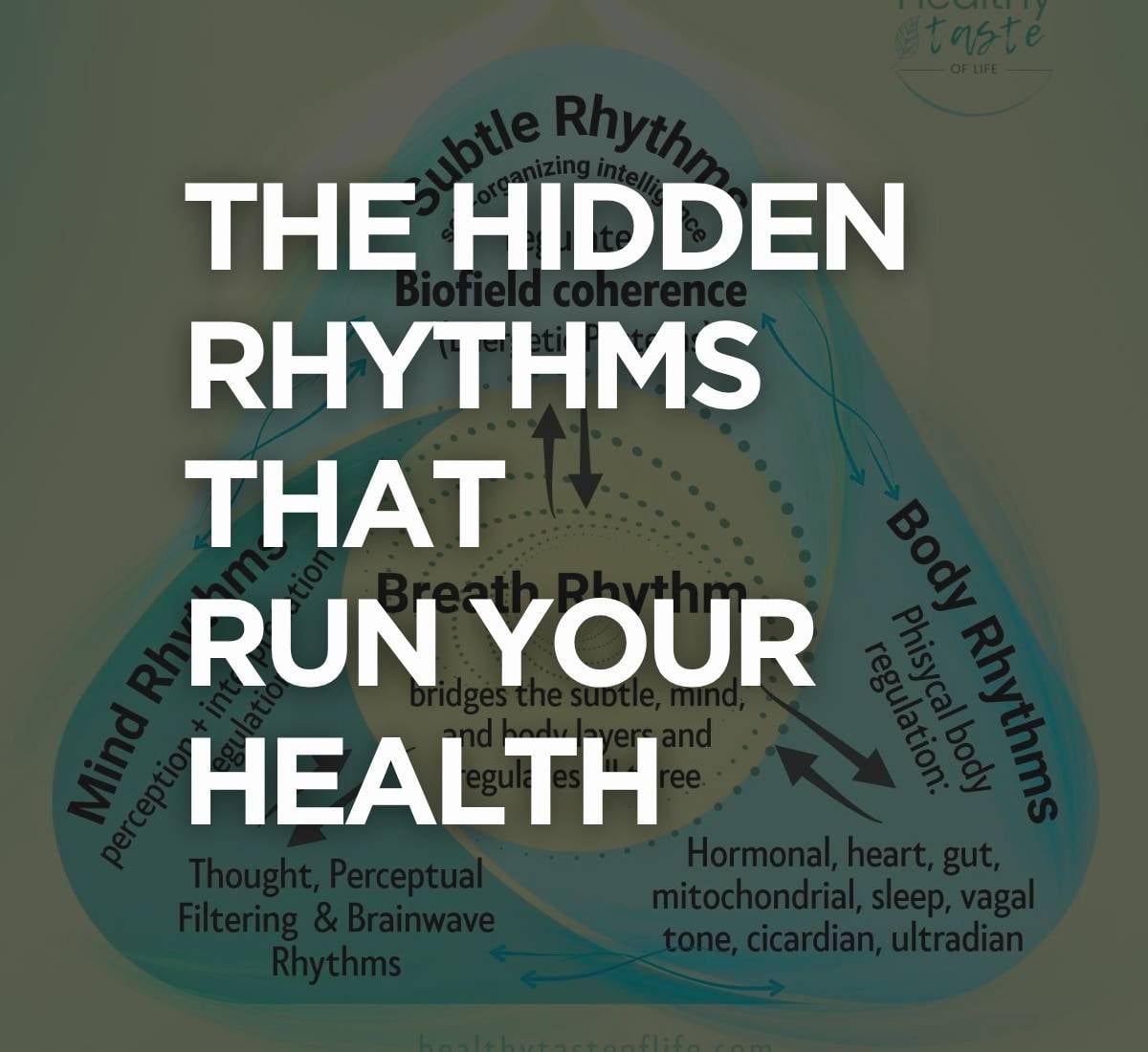
True health is shaped by rhythms: mental, emotional, nervous system, and physical – all influencing each other, continuously. When one stays out of sync long enough, the body adapts the only way it knows how: through symptoms.
Once you understand these rhythms, you can stop fighting your body and start working with it – supporting digestion, immunity, detoxification, nourishment, and regulation together, instead of chasing fixes in isolation.
This article isn’t about telling you to “just think differently” or “just fix your diet.” It’s about helping you see why both matter, why every part is connected, and how patterns upstream show up downstream as the physical struggles you really feel.
If you can read this with an open mind, even for a moment, it might change how you see your health and your life.
I know this because I lived it, and like many of you, I tried everything I thought should work.
For years, I believed health came from doing everything right: eating clean, preparing anti-inflammatory recipes and juices, following detox plans, running functional tests, eliminating triggers, avoiding food sensitivities and intolerances and buying high-quality supplements.
And yet… I still didn’t feel right.
Some months I felt genuinely well. Other days, my digestion would suddenly worsen, my skin issues (eczema and acne) would return, my energy felt inconsistent, and my moods were all over the place. Despite my efforts and focusing on immune-boosting food, my auto-immune symptoms kept progressing.
It was frustrating, confusing and honestly discouraging.
The Turning Point
Until one day I realized I couldn’t live like that anymore – the effort was enormous, the results were minimal, and it didn’t feel fair that someone could eat anything they wanted and feel better than me, while I was working so hard just to stay afloat.
This feeling became so loud that I couldn’t ignore it anymore. I began searching for what else could influence someone’s health beyond medical regimens, food, and all the conventional approaches that clearly weren’t working for me anymore.
After many months of reasearch, it finally clicked, it made perfect sense, but my analytical mind, trained to rely on scientific evidence, fought it. It questioned everything, dismissed it, and demanded proof. So I started experimenting, trying to disprove it.
And let me tell you: mental conditioning is powerful, and shifting beliefs is hard. So if you’re skeptical, I get it. But just for a moment, read all this with an open mind. How much would that change the way you see your health and your life?
Why We Keep Getting Sick: A Simple Real-Life Example
Let’s imagine a typical day:
You start your morning with all the “right” habits: a clean breakfast, your supplements, maybe even a quick meditation. You believe you’re off to a healthy start.
Then the day begins. You check your phone. You rush into tasks. You push through work pressure and family responsibilities.
You override the tightness in your back and shoulders, the shallow breathing, the tension in your gut, the tight jaw. You don’t notice your heart speeding up when you’re in a rush, the frustration when your expectations are not met, the pressure or the worry that accompany that.
By afternoon you’re tired, but you keep going. Your brain feels heavy and fogy, you take a coffee or tea, but you don’t stop. By evening, you’re exhausted, but you tell yourself you’re just “busy.” And you repeat the next day, same thing.
You don’t consciously register any of the internal shifts or even notice your body at all… because you’re used to functioning this way.
But one day… you wake up puffy and inflamed. Your digestion is off. Your energy is flat. Your skin looks irritated and soggy. Your brain feels foggy or anxious. Your whole system feels “wrong.”
So you blame something random: the food you ate, the gluten, dairy, sugar, carbs, seed oils, maybe PMS, thyroid, perimenopause, the weather, the supplements, people stressing you out, the DNA or even “getting older.” And yes these are valid points, and they have their share of influence. But did you pay attention what else is happening (the bigger picture)?
Related: Why You React (Sensitive) to More Foods.
The truth is:
Your body is giving you signals all day long: you just didn’t notice them. Your rhythms were already dysregulated before the symptoms appeared.
You didn’t notice any of this consciously. But your body did.
You weren’t aware of the micro-stresses, the breath changes, the heart rhythm shifts, the emotional contractions. Your rhythms slipped out of balance long before the symptoms appeared.
The imbalance started quietly. This is how most people live: unaware of the subtle changes happening beneath the surface.
And because no one taught us to notice these things, you assume the symptoms came out of nowhere.
They never do.
This is why people can do everything “healthy” and still not heal, because your daily rhythm determines how the body functions.
Why Women Experience This More
Roughly 75–80% of autoimmune conditions occur in women, according to the NIH and the American Autoimmune Related Diseases Association.
Science suggests hormonal and genetic contributors, but psychosocial and emotional load are major factors: chronic caregiving, emotional labor, suppressed needs, self-abandonment patterns, perfectionism, lack of rest or support.
Gabor Maté, MD, describes this in When the Body Says No: Women who chronically override their needs, tolerate emotional pressure, and suppress anger often develop immune dysregulation.
Your health isn’t just biological… it’s relational, emotional, mental, rhythmic, and …. energetic.
Yes, energy=emotions.
The Three Categories of Rhythms That Govern Your Health
I’ve simplified everything into three major rhythm systems:
- Body Rhythms
(your physiological cycles: heart, hormones, gut, mitochondria, circadian) - Mind Rhythms
(your electrical, cognitive, and emotional waves) - Subtle Rhythms
(your biofield, life-force, energetic template).
When these rhythms fall out of sync, you get sick or healing becomes just temporary. When they align, healing becomes natural and sustainable.
Let’s go through each layer with simple explanations and real-life examples.
1. Body Rhythms (Physiological Layer)
Your biological and physiological clockwork that keeps you alive. These are the rhythms modern science can measure easily. They include:
1.1. Heart Rhythm (Physical Beat Pattern)
This is the mechanical heartbeat pattern. The physical rhythm that drives blood flow, supports oxygen delivery, and directly affects your energy, focus, and endurance.
Let’s say uou get bad news – your heartbeat jumps and becomes irregular – this instantly signals “threat” to your nervous system – breath becomes shallow, digestion shuts down, muscles tense, and your body shifts into survival mode within seconds.
1.2. Hormonal Rhythms
Hormones work in rhythm by rising, falling, pulsing, and responding to cues like light, sleep, food, stress, movement, and the menstrual cycle, so the body knows when to wake, digest, repair, reproduce, respond, and recover.
If you often feel tired, wired, moody, hungry, or more reactive at certain times of the day or month, it may help to understand how hormonal rhythms and body patterns work.
1.3. Gut Motility Rhythm (MMC)
The cleansing wave that sweeps the gut every 90 minutes.
Periods of not eating are essential for the gut’s motility rhythm (the migrating motor complex) to activate this natural “clean-up wave” – it clears the digestive tract between meals, and when it’s constantly interrupted by snaking, stress, or late-night eating, digestion slows, bloating increases, and gut health gradually declines.
Then the gut sends distress signals to the brain (gut-brain axis) – the anxiety increases, even without a clear mental cause. And this communication network is bidirectional by the way.
1.4. Mitochondrial Rhythm
Mitochondria produce energy (ATP) in natural cycles, and when these rhythms are disrupted by chronic stress, poor sleep, inflammation, or constant overexertion, cells produce less ATP (energy) – and is showing up in everyday life as fatigue, brain fog, poor exercise tolerance, no motivation, slow recovery and even small tasks feel overwhelming.
1.5. Nervous System Rhythm
The nervous system itself is part of the body’s regulatory rhythms. It’s the physiological rhythm that shifts between:
- fight-or-flight (activation)
- rest-and-digest (calm)
- freeze/dissociation (shutdown)
This rhythm is mostly unconscious and it governs automatic physiological states: your heart rate, breath, digestion, stress chemistry, and muscle tone all change according to this rhythm.
Your nervous system rhythm constantly switches between “go mode” (fight-or-flight=sympathetic) and “rest mode” (rest-and-digest=parasympthetic), and when this rhythm gets stuck on one side – usually the stress side – it affects everything including immune function, and this is how chronic illness begins. In order to switch to “healing mode” you need to be in parasympathetic (rest) more.
The nervous system responds faster than conscious thought. Your body shifts into stress or safety before the mind explains what’s happening.
1.6. Vagal Rhythm
The vagal rhythm is the parasympathetic “safety cycle” of the nervous system (a body-based rhythm) that controls digestion, heart rate, inflammation, breath, emotional balance, and the ability to relax. It belongs to the nervous system, but its effects are so central to physical health.
When the vagal rhythm is smooth and flexible, digestion works well, the heart stays steady, breath is full, inflammation stays low, and emotions feel manageable.
When the rhythm is disrupted (from stress, trauma, or chronic tension) your body stays stuck in “threat mode,” shutting down digestion, tightening muscles, raising inflammation, and making mood more reactive.
The Polyvagal Theory by Stephen W. Porges, PhD explains all this beautifully.
1.7. Circadian Rhythm
Your circadian rhythm is your body’s 24-hour internal clock that coordinates sleep, hormones, digestion, metabolism, and inflammation. This rhythm refers to how your body runs on precise internal schedules: certain hormones rise while others fall, organs become active or rest, digestion speeds up or slows down, body temperature changes, and cellular repair switches on or off – all according to a built-in 24-hour timing mechanism.
When this timing is consistent, your whole system stays regulated; when it’s disrupted, everything from sleep to metabolism to mood becomes harder to balance.
For example, cortisol naturally rises in the morning to wake you up and give you energy, while melatonin rises at night to make you sleepy. If you stay up scrolling or eat late, this timing gets reversed and you feel tired in the morning, wired at night, and your whole system feels “off.”
If you want to read more about specifics how to regulate this body rhythm, see this article: Restore Rhythm for Gut Healing: The Daily Routine That Calms Symptoms.
1.8. Ultradian Rhythm (90–120 minute cycles)
These govern your natural waves of digestion, energy and alertness throughout the day. Pushing through them without breaks leads to burnout. Because of work pressure, stimulants, or constant multitasking, your body shifts into stress mode, leading to fatigue, irritability, cravings, and difficulty concentrating.
Example: You feel a natural dip in energy mid-morning, but instead of taking a 5-minute pause, hydrating, or breathing, you push through with coffee. That “ignore and override” pattern eventually drains your nervous system, focus drops, mistakes increase, and burnout sets in.
1.9. Emotional Rhythm
Why it belongs to the “body rhythm” category? because the emotions are experienced in the body first…
These waves originate in the body through shifts in hormones, heart rhythm, breath pattern, and vagal tone.
Emotional rhythms are the natural rise, peak, and resolution cycles of feelings that move through the body.
Every emotion follows a wave-like pattern: it builds, reaches a peak, and dissipates – usually in under 90 seconds when not suppressed (this 90-second emotional cycle is descrbed in detail by Neuroscientist Jill Bolte Taylor).
Each emotion also produces a somatic emotional signature: a distinct pattern of tension, temperature, pressure, or movement in the body. For example emotional stress tightens fascia and alters posture – breathing becomes restricted – circulation and nerve signaling suffer – pain and stiffness become chronic.
Other examples:
- Anxiety (tight chest, shallow breath, knot in the stomach)
- Fear (cold hands, clenched jaw, hollow feeling in the gut)
- Anger (heat in the chest or face, clenched fists, tight shoulders)
- Sadness (heaviness in the chest, lump in the throat, slumped posture)
- Grief (pressure behind the eyes, tight throat, slow heavy breath)
- Shame (collapsed chest, downward gaze, sinking sensation in the torso)
- Guilt (tight stomach discomfort, restless tension)
- Overwhelm (head pressure, shallow breathing, frozen or rigid body)
- Suppressed emotion (jaw clenching, neck stiffness, upper-back tightness)
- Hypervigilance (raised shoulders, locked neck, constant muscle readiness)
- Resentment (tension along the ribcage, tight diaphragm)
- Joy (unrestricted) (chest expansion, lightness, spontaneous deeper breath)
- Relief (sighing, softening of shoulders, warmth through the body)
These body-based signatures are not psychological; they’re physiological signals.
When emotional waves and their somatic signatures are allowed to move through, the body returns to regulation. When ignored, dismissed, or overridden, they get stored as chronic tension, tight fascia, or persistent stress patterns that affect posture, digestion, sleep, immunity, and pain.
We often ignore emotional rhythms because emotions feel “not real,” or we’re taught to hide them, they start small, they show up as random body symptoms, we value thinking over feeling, and physical problems seem more believable than emotional ones.
Yet emotional rhythms are one of the strongest drivers of physical health, by shaping the nervous system, heart coherence, inflammatory responses, and overall vitality. Ignoring them doesn’t stop them, it just forces them deeper into the body.
That’s why somatic work in therapy is so effective: it allows the body to finally process the emotional cycles that were left unfinished, releasing stored tension and offering real relief from long-held symptoms. Examples of somatic & trauma-informed techniques: EMDR, EFT / Tapping, Somatic Experiencing (SE) etc.
1.10. Sleep Cycle Rhythm
The sleep cycle is the body’s repeating rhythm of deep sleep, light sleep, and REM (dreaming sleep), cycling every 90–120 minutes throughout the night.
In deep sleep, the body repairs tissues, resets hormones, lowers inflammation, and restores physical energy.
In REM sleep, the brain processes emotions, integrates memories, and resolves unfinished stress patterns through dreams.
This rhythm directly affects emotional balance:
When sleep cycles are disrupted (from stress, screens, late nights, or irregular schedules) the emotional centers of the brain become overactive, the body stays in “threat mode,” and you wake up more reactive, anxious, or overwhelmed.
Dreaming plays a role too: during REM, the brain replays emotional content in symbolic form, helping you release charge and reorganize experiences. Without this dreaming rhythm, emotional tension accumulates and the nervous system becomes more fragile.
1.11. Breath Rhythm
- Physically, breath is a body rhythm (lungs, diaphragm, oxygen – CO₂ exchange).
- Functionally, breath is the main regulator of subtle energetic rhythms (biofield / life-force patterns). It is the control dial for the entire system.
Changes in breathing immediately alter heart rhythm, vagal tone, emotional state, and energetic coherence.
Slow, deep, rhythmic breathing signals safety and allows healing processes to activate.
Fast, shallow, irregular breathing signals threat and pulls the system into survival mode.
Because breath directly influences both physiology and the biofield, it acts as the main gateway through which subtle rhythms organize the body.
Did You Notice the Pattern?
Why So Many Rhythms Follow 90-Second or 90–120-Minute Cycles
If you’ve been paying attention, you may have noticed something interesting:
Emotions, gut waves, sleep cycles, focus cycles, mitochondrial output, breath patterns, fascia tension, and even energy levels follow these repeating time frames: 90-second or 90–120-minute. This isn’t a coincidence, it’s how the human system is wired.
- Ultradian rhythms (90–120 minute cycles) regulate daytime energy, gut motility, hormonal pulses, nervous system and sleep.
- Gut motility (MMC) works in repeating waves roughly every 90 minutes when we give it breaks between meals.
- Emotional rhythms follow a 90-second biochemical wave, the time it takes for an emotional charge to resolve in the body (unless the mind keeps re-triggering it). Stress, focus, relaxation, or even dissociation last around 90 minutes before shifting to another state.
- Each sleep cycle (from deep to light to REM) completes in ~90 minutes – the same ultradian rhythm expressed at night.
So what’s going on?
The body operates in wave-like loops (similar to a breathing pattern):
- Activation ➤ recovery.
- Charge ➤ release.
- Stress ➤ reset.
Why? Because 90–120 minutes is the most energy-efficient time window for human physiology – long enough to create change, short enough to avoid overload.
That’s why pushing nonstop, snacking all day, living on adrenaline, or staying in constant mental tension creates problems over time. You’re basically interrupting the reset points your system is designed to have.
Why this matters for healing
When you start working with these natural cycles, your body gets more chances to:
- digest and clean up properly
- downshift out of stress mode
- process emotions instead of storing them
- restore energy instead of burning it faster
- sleep deeper and regulate hormones more easily
You can start noticing which phase of a rhythm you’re in just by paying attention to what your body is telling you: the chnages in breath, tension, temperature, posture, heartbeat, or energy level. Your body always signals where you are in the cycle.
Pay attention when you need more rhythm-friendly breaks, small resets throughout the day are essential.
Once the body’s rhythms make sense, the next layer becomes obvious: the mind has rhythms of its own as well.
2. Mind Rhythms
When the body shifts, the mind follows. A whole world of its own rhythms. These include brainwave patterns, attention cycles, and the way your mind filters and interprets reality. Science maps part of this through EEGs, while the intuitive side of you feels it as clarity, confusion, creativity, or overwhelm.
2.1. Brainwave Rhythms
Your brain runs on different “speeds,”and they reflect the overall operating mode of your nervous system (measurable electrical frequencies).
They’re like the speed of your computer (slow, medium, fast, integration mode):
- Delta (deep sleep, repair)
- Theta (dreamy, intuition)
- Alpha (calm)
- Beta (thinking, analyzing)
- Gamma (high insight)
These brainwaves don’t just reflect your life, they shape it. You can influence them through breath, light exposure, nervous system regulation, and what you consume mentally.
Example:
Checking your phone first thing in the morning forces you into beta, this leads to a cortisol spike (stress chemistry rises), later you feel more anxious, wired, or crave quick energy.
Or… if you’re trying to fall asleep but are watching intense shows or thinking about work, your brain stays in fast beta waves instead of shifting into slow theta and delta. This makes it harder to fall asleep, you sleep lighter, and leaves you waking up groggy, unfocused, and emotionally reactive the next day.
2.2. Thought Rhythms
Thought rhythms are the patterns and tempo of the thoughts themselves. They are not electrical frequencies, like the brainwaves, they describe the mental storyline; they’re cognitive (involving beliefs, emotional load, trauma patterns and meaning-making):
- racing
- scattered, worry
- looping
- calm
- moments of clarity
- creativity
When these rhythms get stuck in loops of stress or rumination, they trigger a cascade: your breath becomes shallow, your heart rate increases, your nervous system shifts into survival mode, digestion slows, hormones destabilize, and inflammation rises. In other words, the way you think directly shapes the way your body functions.
A simple analogy is:
- Brainwaves = the tempo (slow, medium, fast)
- Thought rhythms = the melody (the actual pattern you hear)
They influence each other, but they’re not the same.
Brainwaves tell you how fast the mind is running.
Thought rhythms tell you what direction your mind is running in.
That’s why someone can be in the same brainwave state (e.g., light beta) but have:
- calm, organized thoughts “Let me finish this one task.”
or - scattered, mental pressure, urgency – jumping between tabs, second-guessing etc.
2.3. Perceptual Filtering Rhythms
Your brain doesn’t take in reality “as it is”, it filters it. All day long it decides what to notice, what to ignore, and what to label as important or threatening. This filtering shifts rhythmically depending on your state (stress, safety, sleep, emotional load).
Your brain also predicts before it perceives. It uses past experiences and your current nervous system state to fill in gaps and interpret what’s happening.
That’s why two people can be in the same moment and have completely different experiences. And what you notice or miss depends on the state of your nervous system.
Real-life example:
You walk into a meeting after a stressful morning. In a threat state, you notice faces, tone, and “what could go wrong,” and neutral comments feel personal. But on a calm day, you notice solutions, nuance, and connection – same room, different filter.
Your brain’s perception naturally oscillates between states, such as:
- pattern recognition vs. threat detection
- open-minded vs. closed-minded
- clarity vs. confusion
- focus vs. overwhelm
- curiosity vs. defensiveness
And then there’s the layer most of us never learned about: the subtle rhythms. These are the “quiet currents” that move before your thoughts, before your emotions, and even before your symptoms show up!
Some people might say these are personality traits, but they are actually mind rhythms – shaped by stress, safety feeling, sleep, emotional load, and physiological signals from the body.
3. Subtle (Biofield) Rhythms: The Invisible Patterns That Organize Life
These are the underlying energetic patterns that organize life before anything becomes mental or physical. Think of them as invisible templates that influence how the nervous system responds, how emotions move through you, and how the body holds tension or ease.
Subtle rhythms pulse, flow, expand, contract, synchronize, and reorganize themselves in response to safety, stress, intention, and awareness. In that sense, they act like a higher-level organizing system, creating an “energetic blueprint” that the body and mind tend to follow, even when you’re not consciously aware of it.
Science describes them as biofield and coherence patterns, for example, shifts in field “order vs. disorder,” and measurable electromagnetic activity around the heart and brain.
In spiritual traditions, this same layer is described as life-force or subtle energy (prana, qi, the etheric field). These systems all point to the same observation: life moves in waves, expands and contracts, seeks balance, and responds to intention and awareness.
Different languages, but it’s the same self-organizing intelligence.
And to be clear, this doesn’t mean everything is “subtle and energetic” or that physical factors don’t matter as much. Your body still responds directly to the chemical and biological environment you create (what you eat, what you’re exposed to, how you sleep, how you move, medications, toxins, light, and daily habits). The influence goes both ways: these “quiet currents” affects the body, and physical suff affects how your whole system is running.
What “subtle rhythms” means
Think of them as the “electrical grid” that distributes energy and information before the appliances (organs) turn on.
More and more research in physiology and neuroscience suggests the body isn’t controlled in a simple, straight line (“one cause > one effect”). It’s coordinated through timing, signaling, and patterns happening all at once.
In a nutshell: The body runs on patterns, not just parts.
And nature makes this easy to understand.
You can’t see the wind, but you can see what it does: trees swaying, leaves shift, water rippling, seeds traveling in the air. The wind is invisible but the effects are obvious.
Subtle rhythms work the same way: you don’t see the field, but you see how it shapes: posture, emotional tone, intuition, and whether you react automatically or respond calmly.
Read more about Human Biofield+ Its Role In Health here.
Nature works through invisible organizing rhythms as well: seasonal shifts, circadian cycles, plant phototropism, flock movement, ocean tides… humans are no different – we have inner tides and currents too, and when we learn to work with them, health becomes a lot less confusing.
How Subtle Rhythms Influence the Body (The Sequence)
- Subtle rhythms shift first. Changes in safety, stress, emotion, awareness, or intuition alter the biofield: affecting coherence, flow, and expansion/contraction patterns (before anything physical happens).
- The autonomic nervous system responds. These subtle shifts immediately adjust vagal tone and sympathetic activation, creating a baseline of “safety” or “threat.”
- Breath reacts immediately (reflexive micro-change). Within milliseconds, the breath tightens, pauses, or becomes shallow in response to the nervous system. This is the first physiological change (a survival reflex).
- Fascia responds next (structural adaptation). Fascia, as the body’s most sensitive and conductive tissue, tightens or softens in response to the signal. This is the earliest physical expression of subtle change, creating tension patterns in the body.
- Structural breath patterns change. As fascia tightens (especially around the diaphragm, ribs, neck, and pelvis), the breath becomes physically restricted. This shifts heart rhythm, oxygenation, organ mobility, and vagal tone (nervous system).
- Heart, gut, and organ rhythms follow. Restricted breath and fascia tension alter heart coherence, gut motility, lymph flow, circulation, and diaphragm movement.
- Hormonal and immune patterns adjust last. Over time, repeated rhythm changes influence hormonal balance, inflammation, immune resilience, posture, pain patterns and metabolic stability.
Because subtle rhythms act before symptoms appear, they often go unnoticed. But when these rhythms stay disrupted long enough, the body compensates – fatigue, pain, inflammation, or chronic illness becomes the only way the body can communicate.
Think of subtle rhythms like changes in wind direction before a storm.
You don’t see the wind itself, but you notice:
- leaves moving,
- tree branches swaying,
- water rippling,
- clouds reorganizing.
The wind moves first. And the environment responds next.
In the body:
- Subtle rhythms are the wind,
- the nervous system is the moving branches,
- fascia is the bending trunk,
- breath and organs are the moving leaves,
- symptoms are the storm that appears last.
By the time the storm is visible, the wind has been changing for a long time. Let that truth sink in for a moment.
Autoimmunity in Women: The “Perfect Storm” Pattern
Autoimmune issues disproportionately affect women (75–80%) not just because of hormones or genetics as main cause, but because women live in more emotionally demanding roles (juggling multiple roles), carry more caregiving labor (motherhood), suppress more needs, overcare for others at the expense of themselves and experience greater relational stress in the fascia and nervous system (due to constant emotional scanning).
Examples:
- Hashimoto’s thyroiditis ~90% women
- Lupus ~90% women
- Sjögren’s ~ 95% women
- Multiple sclerosis ~70% women
- Rheumatoid arthritis ~ 70% women
- Celiac disease ~65% women
Women get pulled out of their center more easily, swinging more often between: overwhelm, vigilance, collapse, emotional pressure, self-silencing or self-abandonment.
Which destabilizes: subtle rhythms, mind rhythms, body rhythms, hormones, immune signaling – creating the perfect storm for autoimmune conditions.
The Middle Point: The Rhythm at the Epicenter of All Others
And this is where the whole picture comes together, because there’s one rhythm that acts like the epicenter for every other system.
The one that bridges the subtle, mind, and body layers.
The one that reacts first to stress and restores first during healing.
That rhythm is: breath rhythm – the bridge between all layers (subtle, mind, and body).
Breath is the only rhythm that:
- shifts subtle rhythms (your biofield coherence)
- regulates mind rhythms (brainwaves, perception, thought tempo)
- stabilizes body rhythms (heart, vagal tone, hormones, digestion)
It is the first rhythm to change when something feels off and the fastest rhythm you can consciously influence.
When breath is dysregulated (shallow, tight, fast, holding patterns):
- the vagus nerve tightens
- fascia tightens
- heart rhythm becomes irregular
- digestion slows
- emotions get stuck
- brainwaves change into stress patterns
- subtle rhythms become incoherent
When breath returns to smooth, slow, rhythmic patterns:
- the whole system begins to recalibrate
- safety returns (the parasympathetic nervous system comes back online)
- healing switches back on
Studies show that slow, rhythmic breathing also increases vagal tone and stabilizes HRV (Heart Rate Variability).
Where To Begin
If you don’t know where to begin, begin with your breath.
It is the simplest and most powerful way to influence every other rhythm.
There are many styles of breathwork out there, from very simple to highly advanced, but you don’t need to master any of them right now. Just start with this short basic video, notice how it feels, and let your practice grow naturally from there.
Think of breathwork as the entry point. From there, real healing comes from building a few simple, sustainable habits that support each rhythm: body, mind, and subtle – one layer at a time.
What Healing Sequence Works
To restore an unhealthy body we need to work through a sequenced (from ground up) three-step approach:
[3] BIOFIELD ➤ High-frequency tuning (Holds permanently once body is stable)
[2] MENTAL/EMOTIONAL ➤ Software regulation (Requires an energized brain to practice)
[1] PHYSICAL LAYER ➤ Hardware foundation (Critical priority: Generates cellular life force)
1. Physical Layer (Fix the Hardware First)
The more critically ill or physically damaged a body is, the more you must aggressively prioritize the physical hardware over the mental and energetic software. As the body becomes healthier and more balanced, you can transition into an equal, simultaneous approach across all three fronts.
To address the physical layer: check this very simple but really important Rhythm Reset Guide for Gut Health, Hormones and Immune System or this Hormonal Regulation Guide (How To Read Your Body’s Patterns) and make sure your all good with your diet and know how to build a balanced plate for long term stability.
2. Mental and Emotional Layer (Calm the Software)
When you’re stable with your physical body (your cells have basic biological energy) you can address your mental and emotional layer – your mindset and your emotional triggers that activate your nervous system.
This is done by shifting from automatic, reactive behaviors to conscious, values-based responses, by cultivating self-awareness and reframing past narratives, so you can heal underlying wounds rather than just manage symptoms.
How This Looks: A trigger happens, you notice the story your mind is spinning, but you choose not to believe or engage. (Not on auto-pilot anymore). You pause, regulate your nervous system, and stop the body from constantly pumping out cortisol and adrenaline. You choose a response aligned with your values.
You can work with triggers by yourself (by being more aware, changing the story your mind is telling you, deconstructing feelings, setting clear boundaries). Or you can seek professional support when you feel that its difficult to unpack alone. Look for therapists, somatic experiencing practitioners or coaches, see what’s your best fit based on what you’re looking for.
3. The Biofield and Subtle Energies (Tune the Blueprint)
With a stable physical foundation and a calmer nervous system, your body will be resilient enough to fully integrate and hold deep energetic work.
The subtle (biofield) layer, is the all-encompassing boundary of your entire energy system, as the atmosphere of a planet. It is acting as the ultimate informational blueprint. It dictates how the energy circulates around and in the body. This is reflected in the nervous system first and then the physical body. And it’s bidirectional.
Managing vibrations in the biofield usually involves practices that use sound, movement, breath or intention. You can search that up in more details, if you want.
While the biofield is the ultimate informational blueprint, a physically depleted and exhausted body lacks the cellular energy (glucose and ATP) required to step out of autopilot mental stories. It cannot hold, process, or sustain a change in vibrational or mental alignment.
Trying to heal the energy field or reprogram subconscious stories while suffering from severe sleep deprivation, nutrient deficiencies, chronic fatigue, autoimmune flares or acute physical illness is like trying to install advanced software on a computer with a melted motherboard.
To see where this sits for your unique situation, you can map your current health onto three levels of imbalance:
[ CRITICAL CRISIS ] ➤ Focus: 80% Physical / 20% Mental-Emotional-Energetic
[ CHRONIC DRAIN ] ➤ Focus: 50% Physical / 50% Mental-Emotional-Energetic (The Sweet Spot)
[ OPTIMIZATION ] ➤ Focus: 20% Physical / 80% Mental-Emotional-Energetic

Just to be clear, this isn’t medical advice, it’s my perspective based on experience, research, and working with my own health.
If you want to go deeper, join my newsletter below.
If You’re Tired of Conflicting Nutrition And Health Advice + Want a Simpler Approach To Healthy Eating and Living
Join My Newsletter 👇
I share insights on food quality, gut health + whole-food recipes that support long-term health, without strict rules or complicated meal plans. And much more including holistic health coaching tips beyond nutrition!
Plus, you’ll get access to exclusive resources I don’t always share on the website.
If this perspective resonates with you, here are more related articles to explore:

©HealthyTasteOfLife. Content and photographs are copyright protected and need prior permission to use. Copying and/or pasting full text to other websites and any social media is strictly prohibited. Sharing and using the link of this article is both encouraged and appreciated!