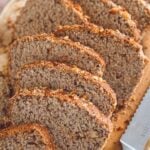
Gluten-Free Sourdough Banana Bread (Soft, Moist, Eggless)
Soft, moist and tender gluten-free sourdough banana bread made without eggs or xanthan gum. Dairy-free yogurt, flax and psyllium create a soft, cake-like crumb, while sourdough starter adds flavor. Make it quickly with active starter or discard, or let it naturally ferment before baking.
Servings 14 slices (1 loaf)
Calories 211kcal
Ingredients
Wet Ingredients
- 3 small to medium ripe bananas mashed (about 1 cup)
- ½ cup thick dairy-free yogurt such as Greek-style coconut yogurt
- ½ cup water or plant milk
- 1 cup gluten-free sourdough starter active or discard*
- 2 tbsp dairy-free butter melted
- 1 tbsp vanilla extract
Dry Ingredients
- 2⅓ cups gluten-free flour blend I used my flour mix
- ⅓ cup sugar
- 3 tbsp flax seeds finely ground
- 1 tbsp whole psyllium husk not powder
- 1 tsp cinnamon
- ½ tsp sea salt
- ½ cup crushed walnuts
For the Quick Rise Method
- 1 teaspoon baking soda
- 1 teaspoon baking powder
- 2 teaspoons lemon juice or apple cider vinegar
Instructions
Mix the Batter
- Preheat the oven to 350°F (175°C) if making the quick version. Prepare a loaf pan. Use parchment paper if needed.
- Mash the bananas in a large mixing bowl.
- Add the dairy-free yogurt, water or plant milk, sourdough starter, melted butter and vanilla. Mix until evenly combined.
- Then add the psyllium husk and ground flax seeds so they could absorb the liquid and form an uniform gelatinous mixture.
- After this add the rest of dry ingredients: gluten-free flour blend, sugar, cinnamon and salt. Add the crushed walnuts after giving a short mix.
- Mix just until the batter is evenly combined. The batter should look thick and slightly heavier than regular cake batter or muffin batter with no visible dry pockets of flour.Finish with a sprinkle of more crushed walnuts on top if desired.
Quick Sourdough Discard Method
- Add the baking soda and baking powder.
- Add the lemon juice or apple cider vinegar and gently mix just until incorporated.
- Transfer the batter immediately to the prepared loaf pan and smooth the top.
- Bake at 350°F for 50–55 minutes, or until the center is baked through and a toothpick comes out clean or with a few moist crumbs.
- Cool before slicing.
Naturally Fermented Method
- Use an active gluten-free sourdough starter and omit the baking soda, baking powder and lemon juice or vinegar.
- Transfer the batter to the prepared loaf pan and smooth the top.
- Cover and leave at room temperature for approximately 4–5 hours, or until the batter looks visibly lighter, slightly aerated and has slowly risen.
- Toward the end of fermentation, preheat the oven to 350°F (175°C).
- Bake for approximately 50–55 minutes, or until cooked through.
- Cool before slicing. See image in the post how the texture turns out different than the quick method.
Notes
Starter: Active starter or discard works for the quick method. Use active starter for the naturally fermented method.
The quick version has a softer, lighter, more cake-like crumb, while the naturally fermented version is slightly denser, more cohesive, and has a more bread-like texture.
Yogurt: A thick Greek-style dairy-free yogurt gives the best consistency. Thin yogurt can make the batter wetter.
Psyllium: Use whole psyllium husk, not powder.
Flour: This recipe was developed with my homemade gluten-free flour blend. Other blends can absorb liquid differently, particularly if they already contain xanthan gum or another binder.
Chocolate chip variation: Replace the ½ cup walnuts with ½ cup dairy-free chocolate chips, or use ¼ cup walnuts plus ¼ cup chocolate chips.
Batter too thick/stiff: If it rolls into a solid ball like bread dough you can gently fold in a tablespoon or two of milk/water or melted butter to loosen it.
a thicker batter will produce a drier and more crumbly banana bread, and a thinner batter will produce a softer and more moist banana bread.
Cooling: The crumb is very tender while warm. Let the loaf cool before slicing so it has time to set properly.
Nutrition
Serving: 1slice | Calories: 211kcal | Carbohydrates: 35.6g | Protein: 3.1g | Fat: 6.7g | Fiber: 3.6g | Sugar: 7.6g | Iron: 0.9mg
